The Sequence · Issue 03 · Interlude
The toddler and the phone
Last week, at a restaurant, I watched a toddler watch a phone. Through the appetizers, through the meal, through dessert. No book on the table, no crayon, no napkin turned into anything.
I don't know what that family's day had been like. I only recognized how easily a phone can fill every waiting minute.
Twenty years ago, many restaurants handed children crayons and paper with the menu. I can't remember the last time I saw that.
And I found myself wondering what those minutes might otherwise hold. In finance, there is a name for that question.
What opportunity cost actually measures
Every finance student learns the definition early. The cost of a choice is not only what you pay. It is the value of the best thing you gave up to make it.
Idle cash is the classic example. It feels safe, and it feels free. It isn't: every year it sits still, it gives up what it could have earned, and that loss never appears on a statement.
I spent more than a decade at Merrill Lynch in Beverly Hills helping people see costs that don't show up on paper. The hardest ones to see are always the ones that feel free.
Now run the math on a child. Say a family eats out twice a week and waits 20 minutes for the food each time. That is about 35 hours a year.
Over ten years, that is roughly 350 hours: small openings to draw, talk, invent, or notice something.
The phone doesn't charge for those minutes, and none of them shows up on a statement. But they still get spent.
I know what one child did with his. We kept it.
The placemat
My son grew up in Dubai. His favorite restaurant was a small noodle shop with orange paper placemats: the name printed in English, Arabic and Chinese, and a bowl of noodles in the middle.
We didn't hand him a screen while we waited. We handed him a pen. He turned the placemat over and went to work.
My husband could never throw those drawings away. When we moved to the United States, every single one came with us. It sounded crazy at the time. It turned out to be the best record we have of how a mind gets built.

What he built
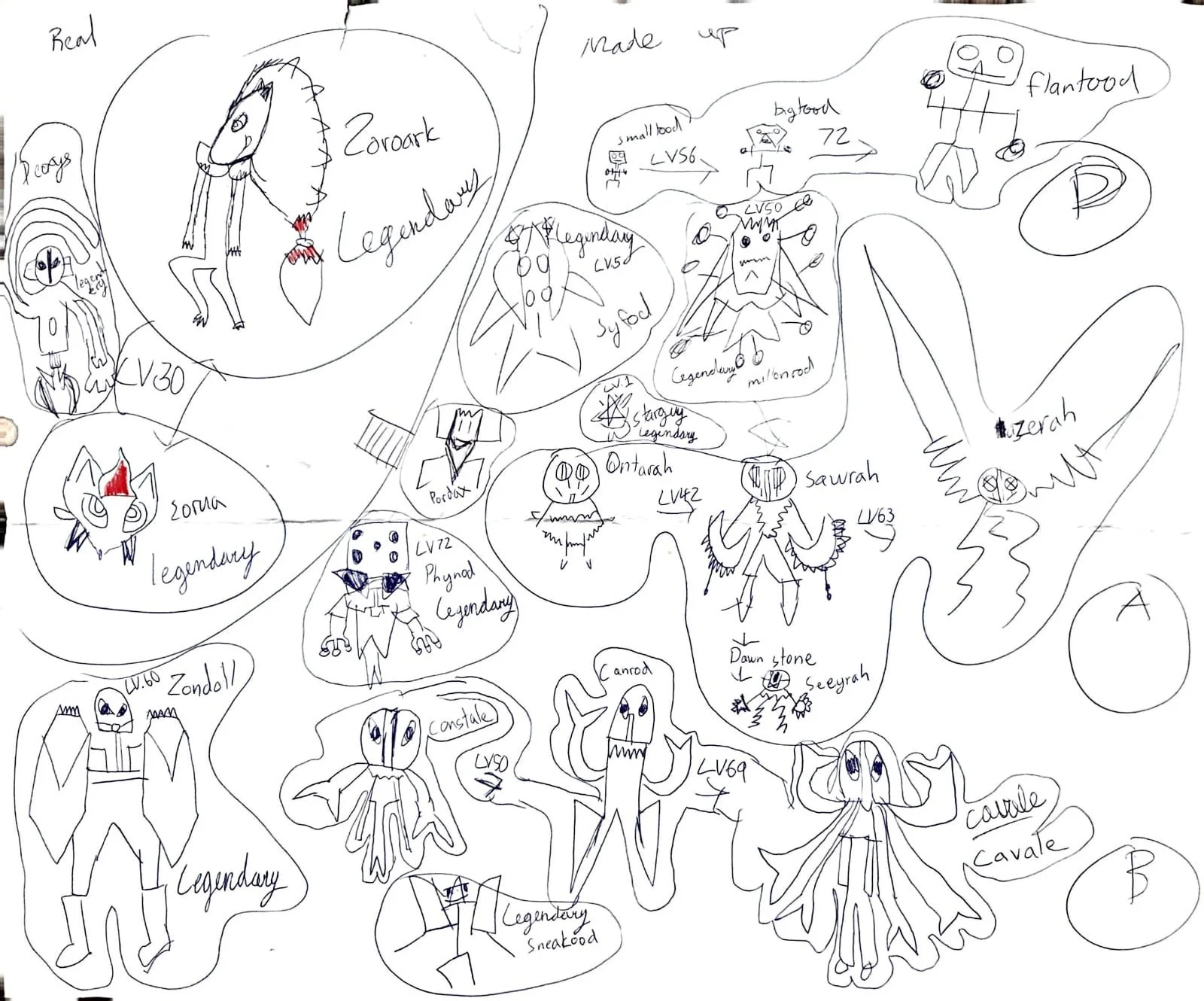
At first glance it looks like a child doodling cartoon creatures. He loved Pokémon, and you can see it. But he wasn't copying. He was building.
A world. Dozens of creatures, each with a name he invented: Sneakood, Zondil, Constale, Flantood. Each one lives in its own territory on the page.
A system. Every creature has a level. Arrows show what evolves into what, LV56 into LV72. A special stone triggers an evolution. A "legendary" class has its own rules.
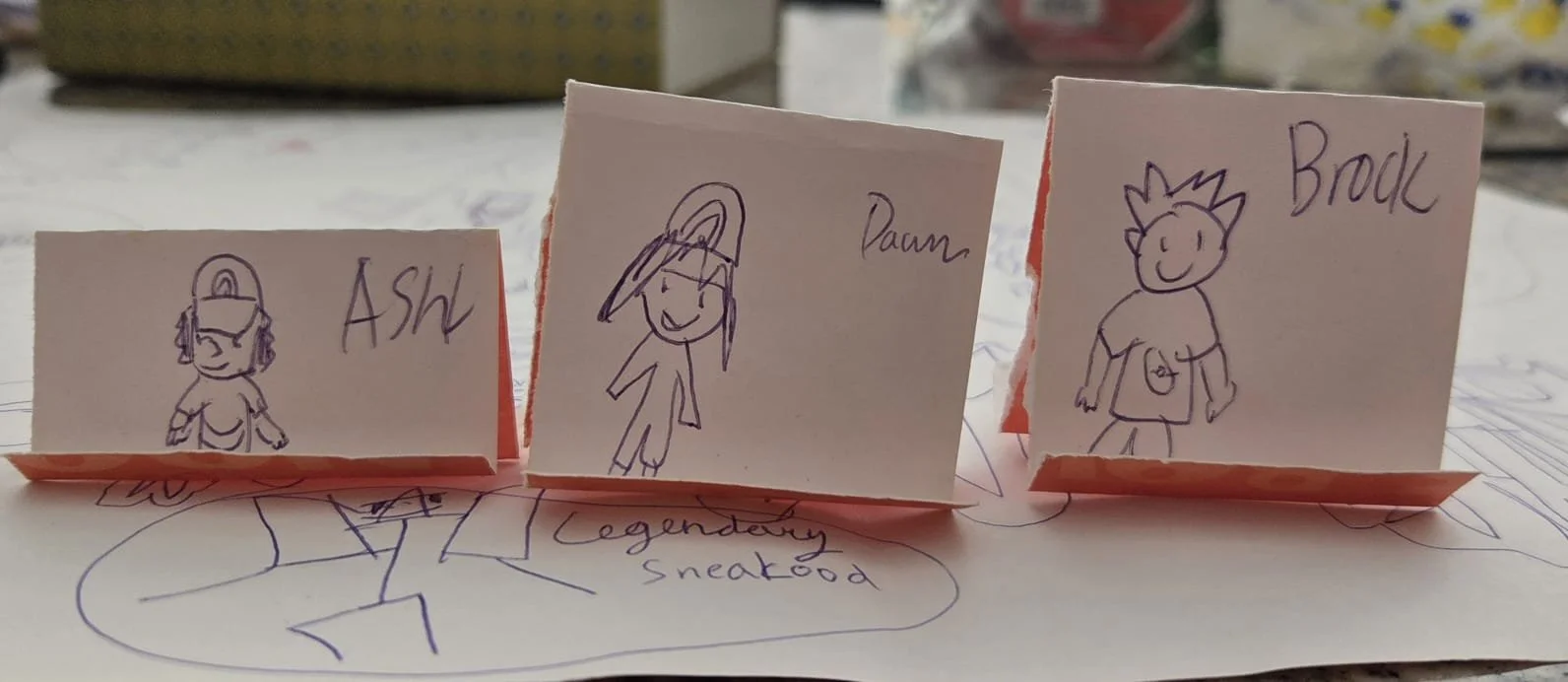
Objects. He folded paper into stand-up figures that sat on the table, so the characters could be played with, not just drawn.
No one assigned this, and no one graded it. The only inputs were boredom, a pen and twenty minutes.
That is what those waiting minutes made possible: a child inventing rules, testing them, and making things with his hands.
The line down the page
One detail on that map stops me every time. He drew a line across the page. On one side he wrote "Real." On the other, "Made up."
He was sorting the creatures that came from the show from the ones he had invented. Nobody taught him to do it. He simply knew the difference between what he had borrowed and what he had authored.
Making things gave him practice deciding what to borrow, what to change, and what to call his own. Those decisions matter even more when a tool can supply the finished image.
On that placemat, he was the one deciding.
Retained earnings
In accounting, retained earnings are what a company keeps and reinvests. Those drawings were ours: not the paper, but the habit of making something out of nothing.
Today my son is a lead editor at a film studio, and he is working on his second short film. I can't prove a noodle-shop placemat made him a filmmaker. But I know what those hours were spent on: inventing characters, building worlds and deciding what happens next. That is still his work.
Watch, then make
This is not an argument against screens. My son watched the show. Then he came to the table and made something from what he had watched.
That is the sequence the placemat shows: watch, then make. The making needs time, and time is exactly what a phone fills so easily.
The opportunity cost of filling every waiting minute is the making that never happens. Not every minute needs protecting. Some of them do.
Art before algorithm was never "no algorithm." It's order of operations.
What did you do with the waiting minutes when you were a child?
Write to me at connect@artbeforealgorithm.com. One line is enough.
— Mimi
Mimi Yoo is the founder of Art Before Algorithm and Managing Director of ExploreXtraordinaire Center, which builds AI education and cross-border academic programs across the UAE, the United States, and South Korea. She spent over a decade as a financial advisor at Merrill Lynch in Beverly Hills before moving to Dubai in 2007, and has worked with the Emirates Youth Symphony Orchestra for nineteen years.
A note on the numbers
The 350-hour figure is an illustration, not a study. A family that eats out twice a week and waits 20 minutes for the food each time spends about 35 hours a year waiting, or roughly 350 hours over ten years.