The Sequence · Issue 02 · Music Before AI
The part you can't build
When I posted about Abu Dhabi's new youth orchestra, a Gehry-designed home with free tuition for children aged six to nine, an architect asked me a sharp question. Which part should other cities copy first: the building, the free tuition, or the early start?
I told him I'd copy the building last. The most valuable thing that orchestra offers isn't concrete or acoustics. It's time. Years of it, protected, starting early enough that a child has room to struggle, stay, and grow.
That answer deserves more than a comment box.
What compounding actually rewards
Every new investor gets shown the same example. Two people each invest $10,000 a year at a 7% return. The first starts at 25 and stops at 35: ten deposits, $100,000 in total. The second starts at 35 and keeps going until 65: thirty deposits, $300,000 in total.
At 65, the first investor has about $1.13 million. The second has about $1.01 million.
One-third of the money. More at the end. The difference isn't how much went in. It's how many years the money had to grow on itself.
I spent more than a decade explaining that math at Merrill Lynch in Beverly Hills. Compounding has two enemies: starting late and stopping early. Then I spent almost two decades with a youth orchestra and watched the same math play out in children.
Skill compounds. The ear trained in year one makes year two's harmony possible. The discipline of year two makes the orchestra seat in year five possible. Each year earns interest on the one before. Quit halfway, and the growth stops with you.
This is where AI enters the picture. An instant answer is a withdrawal, not a deposit. A child who has been depositing for years can afford it. A child who never started has nothing to draw on.
Math before anyone calls it math
A child learning music is doing math long before the word appears on a worksheet. A whole note splits into halves, then quarters, then eighths. A measure has to add up. A phrase repeats, varies, and resolves, which is pattern and structure the child feels before she can explain it.
No one announces the lesson. The concept arrives through the body and the ear, and it sticks because it was lived before it was named. That is the order of operations: experience first, abstraction second.
No free lunch
Music is one of the few things left in a child's life that cannot be rushed. It takes years to play well, and years just to earn a seat in the orchestra. There is no shortcut, no prompt, no instant answer. You practice, you fail, you practice again.
That is delayed gratification, and it may be the most important thing we can teach right now. Our children are growing up surrounded by instant everything: instant entertainment, instant feedback, and now instant answers from AI.
The problem isn't that instant tools exist. The problem is sequence. A child who learns patience and discipline first can later use an instant tool well. A child who meets the instant answer first may never build the patience at all.
The last ones standing
For almost two decades I have watched young musicians come and go in a youth orchestra in the UAE. Many children start. Fewer stay. The ones who stayed, the last ones standing, were the real winners. The discipline they built in rehearsal rooms carried them into college, into careers, and into whatever came next. Staying compounds.
The largest study on this points the same way. Researchers at the University of British Columbia followed more than 112,000 public school students in British Columbia. Students in school music scored higher on math, science, and English exams than their non-music peers, even after accounting for socioeconomic background and prior achievement. The more music courses students took, the higher their scores, and the pattern was strongest for instrumental students. The most engaged instrumental students were, on average, about a year ahead academically.
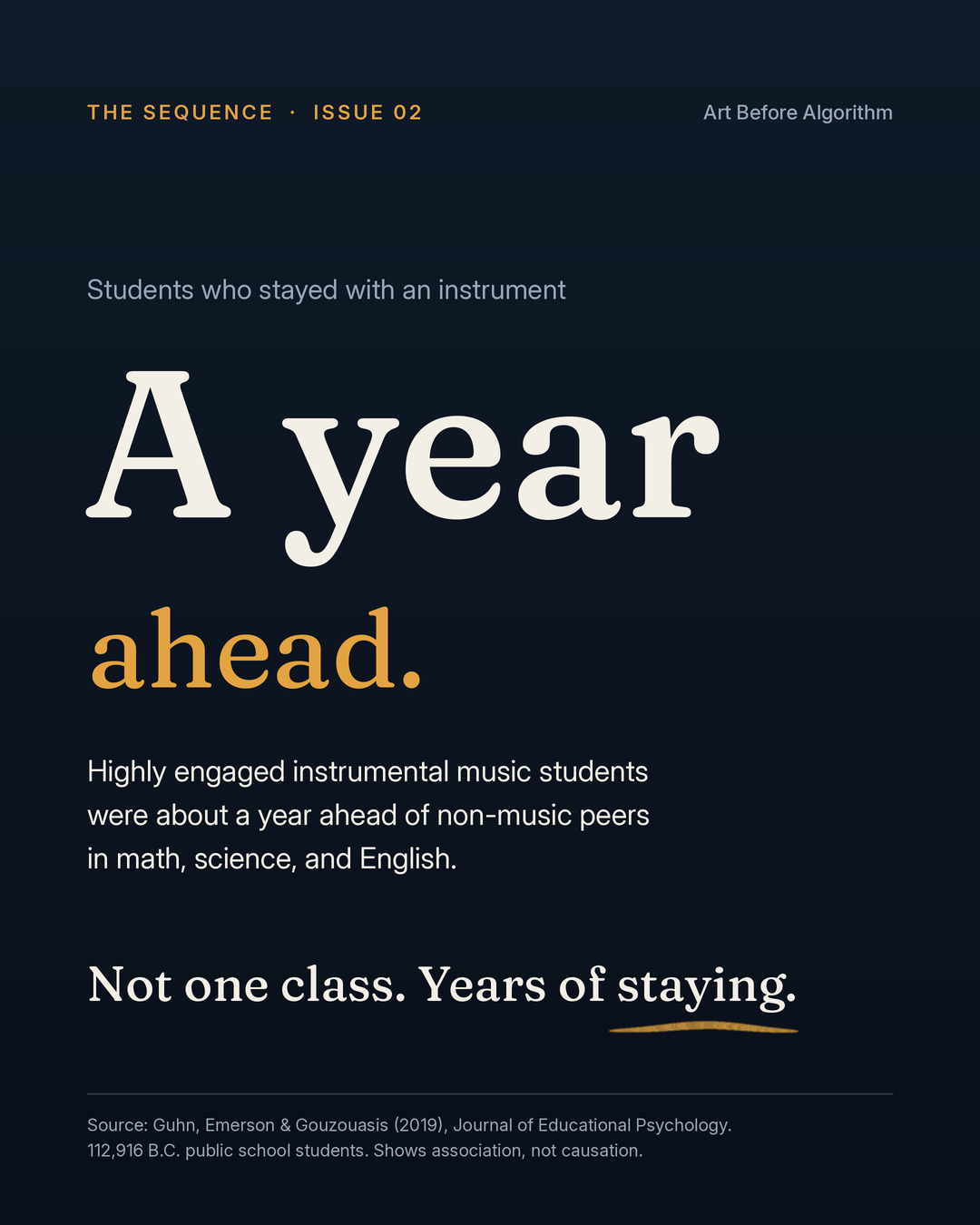
An honest note: that study shows a strong association, not proof that music alone causes higher scores. Controlled experiments on music and test scores are mixed. But notice what the data rewards. Not a single class. Not a semester. Sustained engagement over years. It rewards the children who stayed.
What cities should copy first
So, back to the architect's question. Copy the runway, not the landmark.
Start early, because six is when the foundation goes in. Make it free, because cost is the most common reason families pull a child out halfway. Then protect the years in between, because that is where the compounding happens.
The building is the signal that a city believes music is infrastructure. But a converted school gym can do the same job if the program inside starts early, stays free, and keeps children long enough to become who they are capable of being.
We keep asking when to let AI into children's lives. The better question is what we build in them first. Patience. Discipline. The memory of working for years at something hard and finally earning it.
There is no free lunch. And that is exactly the lesson.
Order of operations. Always.
So one question, and I read every reply:
What's one thing your child, or your students, have stayed with long enough to earn?
Write to me at connect@artbeforealgorithm.com. One line is enough.
— Mimi
Mimi Yoo is the founder of Art Before Algorithm and Managing Director of ExploreXtraordinaire Center, which builds AI education and cross-border academic programs across the UAE, the United States, and South Korea. She spent over a decade as a financial advisor at Merrill Lynch in Beverly Hills before moving to Dubai in 2007, and has worked with the Emirates Youth Symphony Orchestra for nineteen years.